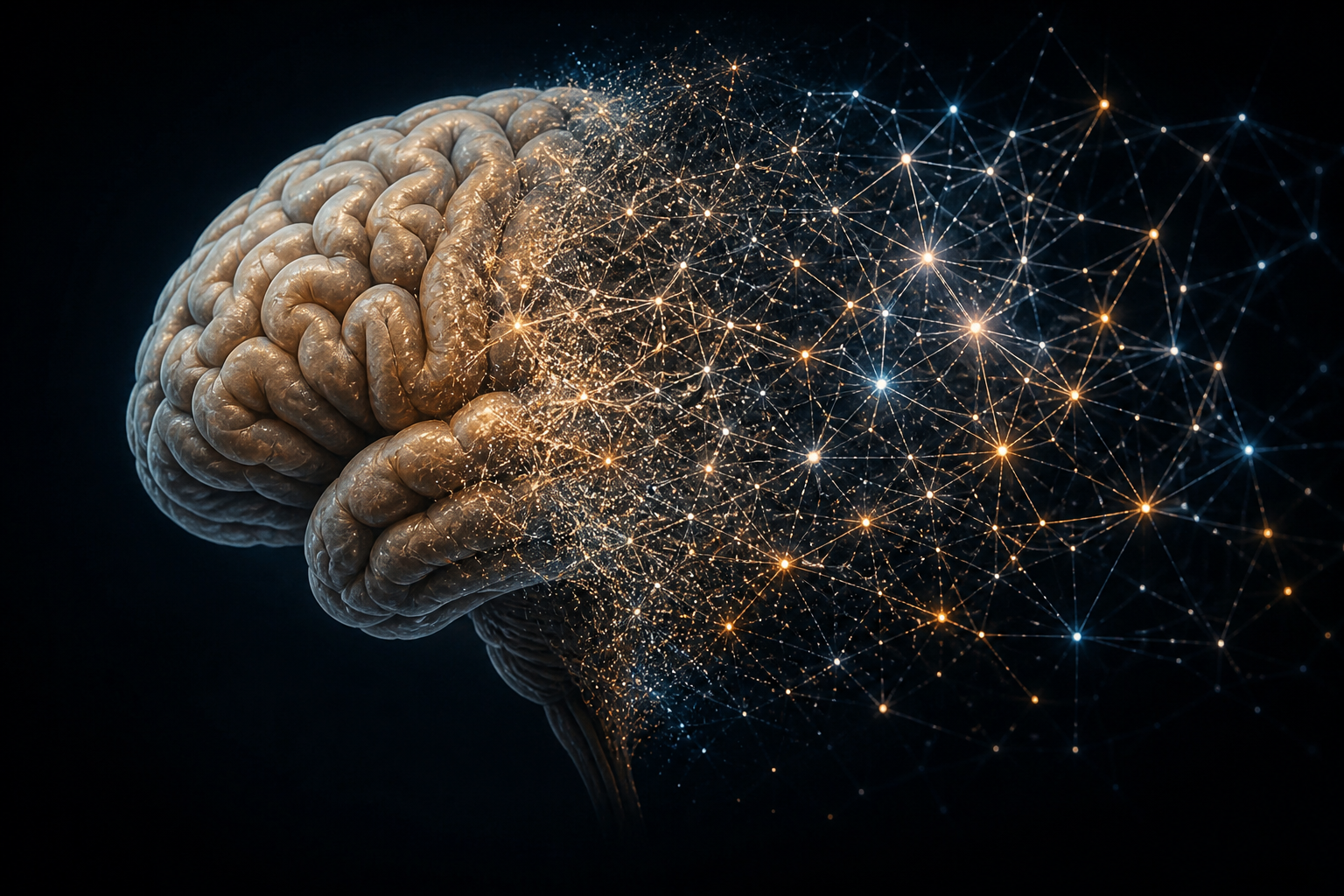
At its core, I think Al isn’t just a tool. It’s a signal that intelligence itself is reconfiguring. We think of cognition as something biological, but I think AI is showing that intelligence may be more of a fluid, evolving system that doesn’t necessarily need a human substrate.
Right now, Al functions like an amplifier, enhancing human capabilities in ways that feel incremental-better automation, more efficient workflows, faster decision-making. But at the same time, there’s something deeper happening: Al is reshaping how intelligence operates.
Intelligence can be something non-human and distributed in ways we don’t fully understand yet. Even if it’s still reliant on human input for now, the fact that it’s producing novel outputs-writing, even creative insights-suggests it’s not just a tool but a force of its own.
Maybe the real question is: at what point does Al stop being an “extension” and start becoming something independent? When it no longer just reflects human knowledge but generates its own models of reality? That’s when the paradigm shift becomes undeniable.
I think the point might be when AI has the capacity to generate independent ideas without relying on recursive patterns of past, embedded knowledge. But that might be too much of a standard because even humans are not held to that.
The real distinction then might not be whether Al can break from recursion entirely (even human creativity is a form of sopt recombination), but whether it can do what humans can do: abstract patterns from disparate de challenge its own assumptions, and generate insights that are not just probabilistically novel but conceptually unprecedented.
Al today doesn’t yet have the drive to pursue knowledge for its own sake. It doesn’t have internal motivations, contradictions, or the kind of messy, self-referential cognition that leads humans to explore frontiers for reasons beyond pure optimization.
But if Al ever reaches a point where it’s identifying problems, generating hypotheses, and iterating on ideas without human prompting, then we’re looking at something qualitatively different.